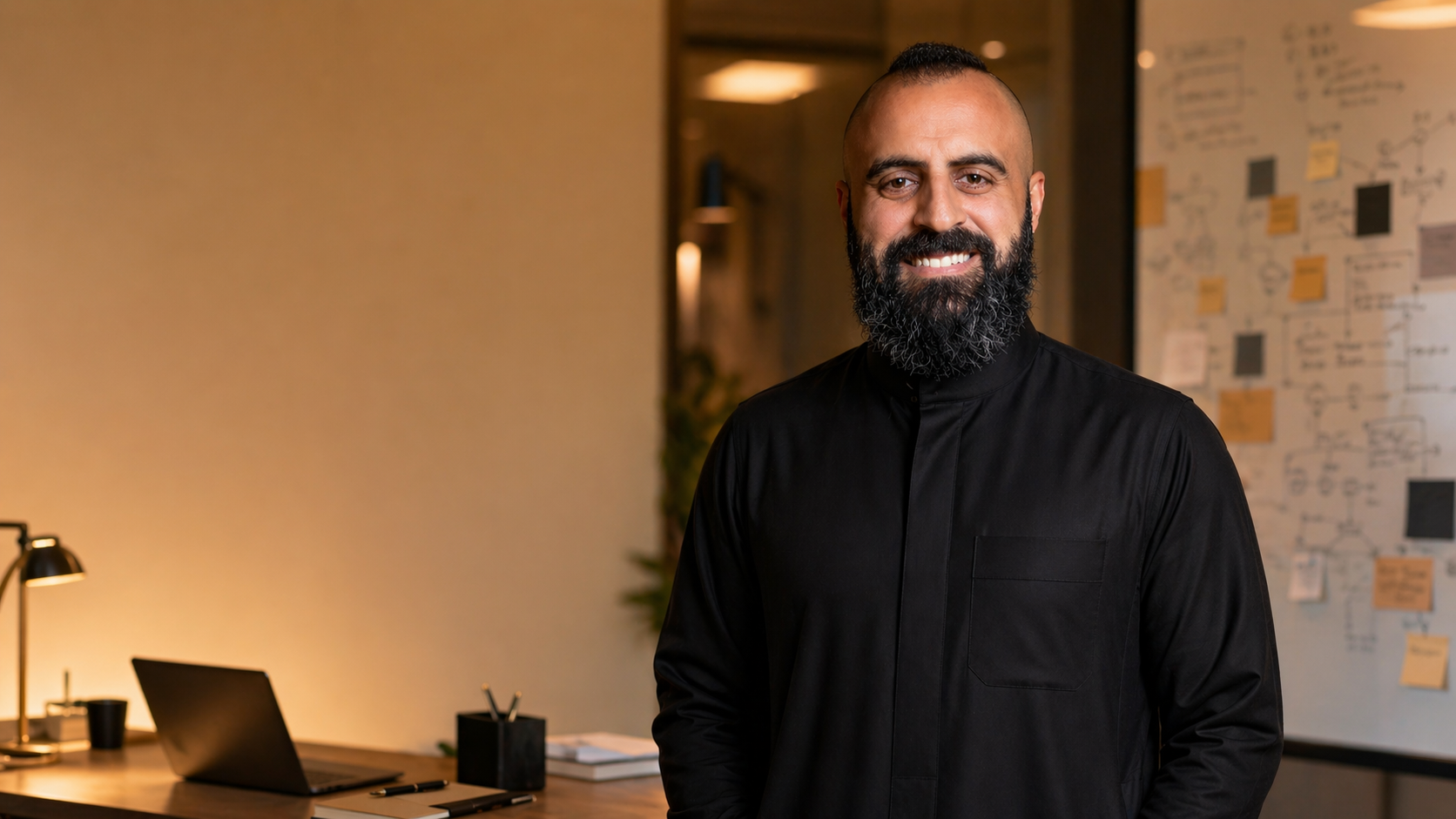


I was sitting in my car during my lunch break, opening a package I had ordered from Australia.
My brother had seen me growing my beard and told me, “Yo, you gotta use beard oil.” I did not know beard oil was a thing. I went online, found a company, placed an order, and waited a couple of weeks for it to arrive.
The package was beautiful. There was a little card inside, something like “Welcome to your beard,” a few branded materials, and a small brown bottle. I opened it, smelled it, put a couple of drops in my hand, and worked the oil through my beard.
The scent hit immediately. I pulled down the sun visor mirror, checked myself, then looked into the rearview mirror.
Oh yeah, baby. I smell good. I look good.
What surprised me was how excited I felt. I was not someone who regularly posted products on social media, but I took a picture of that bottle and shared it straight away. No reservations.
It was oil. That was all. But it had turned taking care of myself into something playful, masculine and communal. It gave me a ritual, and it made me feel as though I had entered a world I did not know existed.
To understand why that mattered, you have to understand that the beard had never felt neutral to me.
I was in grade ten in Saudi Arabia when 9/11 happened. Afterward, I became more conscious of how Arab faces were being read, especially while travelling. The advice in the conversations around me was practical: if you are going through an airport, shave. Look less Arab. Reduce the friction. Avoid being “randomly” searched or questioned.
I understood why people said it. But when you keep making those calculations, you begin to understand that other people can assign meaning to your face before you have said anything. Eventually, you may start editing yourself before they get the chance.
For years, I experimented with facial hair without thinking too deeply about it. A goatee. A chin strap. Clean lines. Whatever seemed acceptable at the time.
Then, in 2014, I went to a wedding with my wife and partner, Samya. The hall was beautiful, light was streaming in, and everybody was dressed to the T. In the middle of the groom’s friends was a guy with a big beard, a bow tie and suspenders. He was jacked. He looked like Mr. T.
He was not the tallest person in the group, but he was the one your eyes went to. He was dancing, jumping, celebrating his boy and making the party a party. He looked like someone you wanted at your party and someone you wanted to be friends with.
I remember looking at him and thinking, I want to look like that guy.
It was not only the beard. It was the comfort he seemed to have in himself. His beard looked stylish, confident and fun. He did not look like he was apologizing for his face. He looked like he was enjoying it.
That wedding changed what I thought a beard could look like. I kept growing mine.
The beginning was awkward and itchy. It grew unevenly, and everybody had an opinion. People asked if I had become religious or conservative. Some joked, “What is this, Daesh?” My face had become public property.
My intention was much simpler. I wanted to look good. I wanted to express myself. In the formal institution where I worked, growing the beard also became a small rebellion against the feeling that I always had to make myself acceptable to other people.
After about six months, I shaved it off.
I was standing in the small bathroom beside our bedroom with the trimmer in my hand. I think I began by cleaning up the sides, then shaped it into a goatee, and finally thought, okay, let’s shave this.
When I looked up, half my face had disappeared.
My face looked diminished. The hair was sitting in the sink. I could suddenly see my lips again, and all I could think was, my lips are so small.
The regret was immediate. I had only been growing the beard for a matter of months, but shaving it felt like shaving off part of my identity. That was the last time I ever shaved that close.
The beard had started as a look. Somewhere along the way, it had become part of how I recognized myself. Then care turned it into something more.
The beard gave me a culturally familiar way to enjoy scent, softness, skin, grooming and appearance without feeling that I had stepped outside masculinity. I could have a large Arab beard and also say that I liked how an oil smelled on me. I could care about how soft the hair felt. I could use words like “lovely.” Nothing about that felt like a contradiction.
I do not mean that every Arab man experiences his beard this way. I can only speak from my own face, my own history and the men I met through the work that followed.
Once I discovered beard oil, I began noticing beard companies everywhere: Australia, Europe, the United States. They had great packaging, playful language and entire communities built around men taking care of themselves.
Then I asked what seemed like an obvious question: where was the Arab beard company?
There were plenty of beards around me. There was already a deep relationship with oud, misk, incense, oils, perfume and presentation. There were a lot of beards, but there was not much beard care being discussed as a modern category.
I thought it would be simple. Take some oils. Mix them. Give the product a name. Build a cool brand. Bada-bing, bada-boom.
That is how you think before a business teaches you what a business actually is.
The name came while Samya and I were travelling. Someone commented on a photo of us and asked what her husband was doing with his face. Samya replied, “Why? I’m digging it.”
We looked at each other.
In Hijaz, دقن—pronounced something like “dig in”—is used around the chin and beard. Diggn’It worked in English and Arabic at the same time. Once we heard it, the name felt too good to waste.
When we returned to Jeddah, we brought the idea to our friends. A chemical engineer joined us as a partner and carried the formulation work. A graphic designer joined the project and built the identity. Samya built much of the brand’s early rhythm on Instagram, took photos and kept Waseem Wednesdays alive before we had finished products to sell. Our families smelled samples and gave feedback. I carried little containers of oil everywhere and asked people to smell them.
We also went looking for what already existed in our own culture. I sat beside my grandmother and asked what people used for their hair. She looked at me as if I had asked whether water was wet.
Everybody knows, she told me. Ma’roof.
She began listing oils people had used for generations. I was discovering as an entrepreneur what had been ordinary knowledge to her.
Wallah, I had no idea.
That changed the meaning of the brand for me. We were not simply importing a global beard trend and putting Arabic on it. The culture of care was already there. The opportunity was to recover part of it, give it a contemporary form and make it easier for men to participate in it openly.
I understood that more clearly at one of our first market events in Jeddah. Much of the room was devoted to women’s fashion, cosmetics and accessories. Then, in the middle of it, stood our booth: wooden crates, traditional fabric, black bottles, misk, oud and a large bearded logo.
People kept walking up and asking, “What is this?”
I had to learn how to answer in real time. I found myself saying, “Men, you got to take care of yourself too.”
That sentence was closer to the real business than any product description. I was not interested in telling men to “man up” or “be a real man.” The message behind Diggn’It, as I understood it, was simpler: value yourself. Look good. Take good care of yourself.
Looking back after more than a decade in this field, I think that is where my definition of male beauty began to take shape. It is not only conventional attractiveness. It is a man’s relationship with care—what he permits himself to notice, express, improve and enjoy without feeling that his masculinity is under threat.
For me, the beard made that permission visible. It carried the meanings other people had placed on it—religion, danger, tradition, seriousness—and still made room for scent, play, softness, confidence and self-respect. Diggn’It did not try to define Arab masculinity. It gave us a way to explore one expression of it through care instead of instructions about how a “real man” should behave.
The beard began as hair on my face. Then it became a ritual, a product, a company and a conversation.
But first, it was permission.