
What a Men’s Grooming Company Should Never Make a Man Feel
Diggn'It rejected two beard-comparison images because the groomed side appeared to add hair. The decision raised a harder question: can a grooming brand offer change without making the customer feel incomplete?
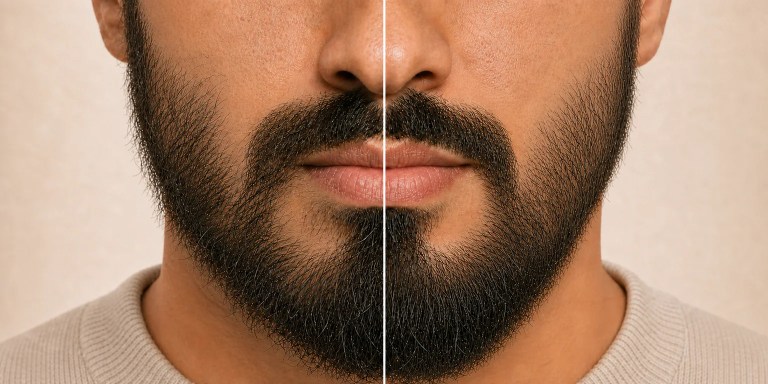
We rejected two comparison images for the Diggn'It homepage. Both showed the same face: lighter-looking areas in the beard on one side and a better-groomed result on the other. But the groomed side appeared to have more hair.
The replacement had to preserve the same apparent hair count. We could align and lift the existing strands and improve the light. We could not quietly give the man a different beard.
The harder question was what those first images asked the customer to believe. They showed something he did not have, then placed our product on the path between the two faces. That is a powerful way to sell. It is also where a grooming company can stop respecting the person it wants as a customer.
After more than ten years in men's grooming, I still believe in self-improvement. A man may want his beard to look fuller or more even. He may want his skin to feel more comfortable. His moustache may refuse to sit the way he wants it to. None of that means he hates himself.
Self-acceptance does not require indifference. A man can love himself as he is and still enjoy changing how he looks. The desire to improve one thing is not a confession that the whole person was wrong.
But a company cannot tell him to accept himself in one breath and spend the next magnifying every uneven area until it feels urgent. If the desire belongs to him, a product can serve it. If we have to deepen his discomfort to make the sale, we are no longer helping him act on a choice. We are making the choice harder to refuse.
Our homepage says, “Not every beard problem is the same.” We use the word problem because avoiding it altogether would make the page less useful. A man looking for help with an uneven or thinner-looking beard should not have to guess whether we understand what he means or whether a product is relevant to him.
Respect does not mean pretending the concern is not real. It means keeping the concern specific. I want to groom this area differently leaves the man in charge. My face is wrong turns the concern into a judgment about him. Marketing crosses the line when it encourages the second feeling to make the first purchase more urgent.
We met the same line when we reviewed what we could say about our Derma Roller. The most attractive story was new beard growth. We looked for direct evidence that it grows new beard hair. We did not find it. So we stayed with the routine and a fuller-looking, better-kept appearance.
That difference is larger than two marketing phrases. One says we may help you work with the beard you have. The other asks you to believe we can change your biology. When the customer already wishes something were different, that promise carries more weight than ordinary product copy.
I wish I could say the more restrained version will always be better for business. We did not measure whether the rejected images would have sold more or less. A dramatic comparison is easier to understand. A sharper promise can create urgency. Our commercial interest does not disappear because we have a respectful sentence in a brand document.
Diggn'It's rule is to speak to men with respect, not insecurity. The real test comes when a headline that makes the problem feel worse, or an exaggerated image, looks likely to make more money. I do not know that we will get every version right.
The question I want us to keep asking is what remains if the man says no. Does he leave with clear information and his choice intact? Or does he leave newly aware of a defect that we have offered to repair for a price?
A grooming product can offer change. It should never become the price of feeling acceptable.
The same apparent hair count began as an image instruction. It was a refusal to invent an absence in a man's face and then offer to sell it back to him.