

For a while, one of the most important things Diggn'It owned was a bag we carried in the car.
Inside were roughly twenty or thirty samples in small plastic containers. Each one had a piece of tape and a coded number. The bag came to family gatherings and events. We passed the samples around and watched people's reactions. Which one did they like? Which one smelled too oily? Which one felt wrong? Which one made someone stop and ask to smell it again?
We took notes by hand.
My parents, Samya's parents and our partners' parents smelled things and reacted honestly. They asked what we needed and how they could help. We funded the early work from our own savings. What family gave us was practical and emotional: attention, encouragement and the feeling that the idea was worth taking seriously.
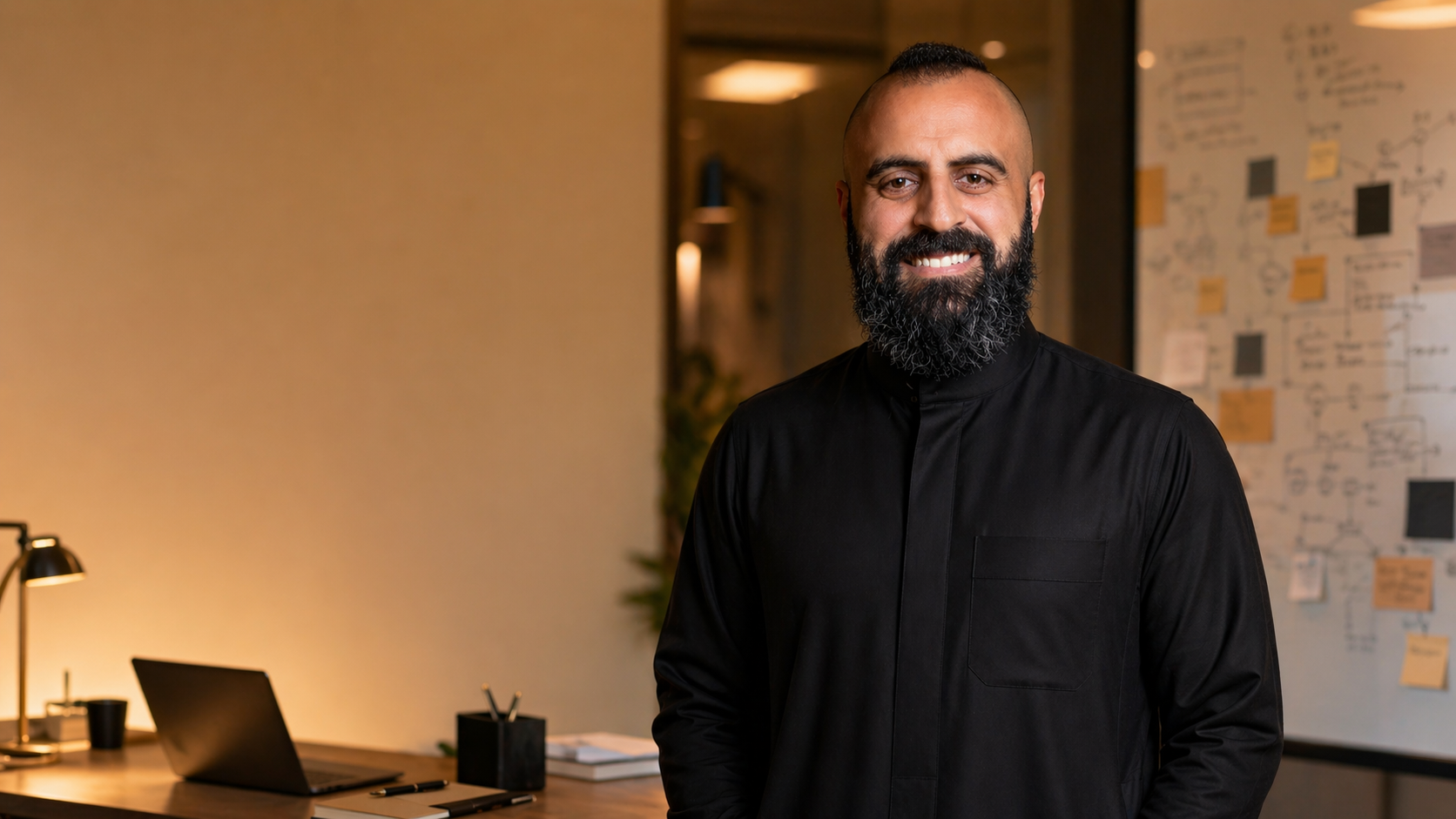
It would be easy to look back at me carrying that bag and turn the whole thing into a founder story. I had an idea for an Arab beard-care company and built Diggn'It. I was the beard in the pictures, the person in the videos and the one standing behind the table explaining the products. I was often the face, the point person and the one connecting pieces.
But this was not an alone feature.
Long before we had products ready to sell, my wife, Samya, was giving the brand a rhythm. She took pictures, helped put posts together, found memes and kept Instagram active. Waseem Wednesdays was built around my beard appearing somewhere new each week, but Samya was often the reason the picture existed and the Wednesday happened.
The beard was mine. The rhythm was ours.
Our partner and friend made the physical product possible. She carried formulation, then production, logistics, shipping and much of the early supply chain. Calling that "help" feels too small. The brand could be playful in public because she kept making sure there was a real product behind it.
Our friends brought what they knew. A designer friend gave the brand its visual language. Our lawyer friend helped us think through legal questions. A friend who understood business processes was starting an ERP, or business-management software, company. He helped us organize raw materials, costing, inventory and data before we fully looked like an organization. Another friend helped with accounting and operational support.
At events, customers kept asking what beard oil was, what balm did and why anyone would use either one. Their questions became our FAQs, videos and explanations in Arabic. Buying was only part of what they gave us. They showed us what we still did not know how to say.
This is why I think of people as Diggn'It's first infrastructure. But even that sentence is a little too clean. Software did not arrive one day after a purely human beginning. One of the people carrying us was already building an ERP company. As I remember it, we became one of his first clients, so software thinking was in the room early. Even the software arrived through a friend.
The real difference was where the work lived. Samya knew when Wednesday needed a new picture. Our partner knew what a formula needed and when supplies were running low. Family reactions ended up in handwritten notes and in our memory of their faces. Customer questions stayed in conversations until we learned how to answer them.
None of that could be seen in one place. The company moved because people remembered, noticed, corrected and showed up.
This is where I have to be careful with the word "infrastructure." It can make people sound interchangeable. They were not. A role can explain what someone did. It cannot explain why they kept coming back to do it.
They kept coming back because they cared about us and were excited by the idea. Sometimes they had a skill that could make it better. Sometimes they just gave an evening to a company that barely existed.
I do not want to romanticize the unpaid part. Much of it was a gift, not a business model. We also could not leave important work in people's heads forever. Eventually we needed clearer roles, records, processes and tools.
Software helped us give parts of the work a more durable place to live. It made orders visible. It helped organize inventory, costs and raw materials. Later systems made the business less dependent on someone remembering everything at the right moment.
We needed that. But the software did not take over the founding credit. It inherited work that people had already been carrying.
This is the part a clean founder story can lose. "I had an idea. I saw a gap. I built a company." It travels well because one person fits easily inside a sentence. The true sentence is harder to keep short.
I may have been the face and the point person. I connected pieces and pushed the idea into the world, and I am proud of that work. I am also clear that none of it would have mattered without everyone else.
When I say Diggn'It belongs to them as much as it belongs to me, I mean it as a correction to the founding story, not a polite thank-you added at the end.
When I remember that bag, I do not see an early customer-feedback system. I see family holding coded samples and telling us the truth. I see our partner making the product. I see Samya making sure people knew we were still there. I see friends bringing whatever they knew how to do.
They were not supporting a company that had already been built. They are part of how it became one.