
Freedom Is Logistics
I could work from Bali because other people still knew where the stock was, made the products, packed the orders and kept them moving. The freedom was real, but the work had not disappeared.
The flight from Jeddah to Singapore was almost empty, which is the kind of luck you understand differently once you have traveled with a baby.
Samya and I were flying with our ten-month-old son. It was overnight, and there seemed to be more staff than passengers. Because so many seats were open, Samya moved with our son into a darker section so he could sleep. A flight attendant came over with a light and told her she could not stay there.
Samya looked at her and said, "If this baby wakes up, I swear to God, I'm going to make you hold him."
That was the biggest incident on the flight, which is how you know it went well.
When we landed in Singapore, I remember seeing dried meats hanging in a shop window with Asian lettering across the front. We had closed our eyes in the Arab world and opened them somewhere that felt like the other end of an old trading route. We still had another flight to Bali. When we arrived, we had somewhere to stay for two weeks. After that, we would figure it out.
But in Singapore airport, the feeling landed.
We did this.
The three of us had packed the bags, crossed the night and reached the other side with the baby still mostly happy. It was a family achievement. The business side of it depended on people who were nowhere near the airport.
The first time Diggn'It had to operate without me in Saudi was months earlier, when Samya and I went to Canada to have our son. I handled the website, ecommerce, marketing, sales and customer questions. Our chemical-engineer partner carried the operation on the ground: production, logistics, fulfillment and shipping. Another friend helped with accounting and operational support.
It is easy to compress all of that into one sentence: I managed the business remotely.
Remote described where I was. It did not describe where the work was.
I could answer a customer from Canada because somebody in Saudi knew where the stock was. I could keep the website moving because somebody else could make a batch, pack an order and get it out of the door. My work traveled through a screen. Hers still involved bottles, boxes, inventory and couriers.
She carried that while we went and had the baby. Any honest account of my freedom has to say that clearly.
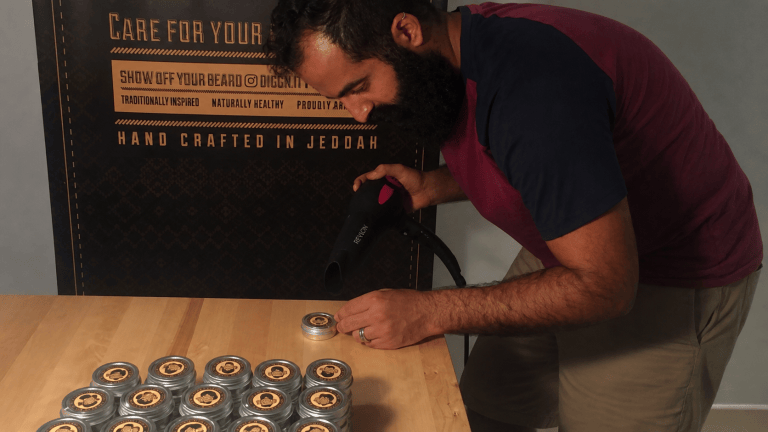
At the beginning, there was almost no distance between Diggn'It and our home. We made the products there. Friends came over for what became assembly parties. We filled thirty-milliliter bottles with something like a salad-dressing dispenser, added the caps and stickers, then sealed the tops with a heat gun. The finished bottles sat in rows on the table. The house smelled like mint, oud, rose and amber.
When an order came in, we printed the airway bill, put the bottle in a box, put the box in a shipping bag and left the day's parcels by the door for pickup.
If we wanted to move, those bottles had to go somewhere.
They moved in stages. Production left our apartment and went into a room made available by our partner's family. We bought a filling machine. Our partner could take fuller charge of the batches. Later, after we returned from Canada, we knew the business could not keep depending on stock and equipment living in her family's room.
Before Bali, that partner and I flew to Dubai to meet manufacturers and logistics providers. One manufacturer picked us up from the airport and took us straight to his factory in the Sharjah Free Zone. There was a small office at the front. Behind it were filling machines, heat machines, boxes, packaging materials and gels. I remember putting my hands into a bright blue gel without being entirely sure what it was for.
We showed him the products and told him the Diggn'It story. He was generous with us. He explained what he could help with, encouraged us to meet other companies before deciding and introduced us to people we might need.
One of those people was starting a third-party logistics business. He was the right size for us: large enough to hold and move stock, small enough that our business mattered to him. His plan was to consolidate shipping across several brands and help send orders into Saudi and the Emirates.
We chose to work with them. Manufacturing moved to the Emirates. Stock went to the logistics provider, which held it and fulfilled orders. We closed the home operation.
The bottles did not become digital because my work did. They went into another factory, another storage space and other people's hands. Somebody still had to make them, count them, pack them and send them out. The work had moved out of my sight. It had not disappeared.
We also learned that not every part of the business was ready to move.
We tried outside marketing teams. They could make polished visuals, but I kept feeling that they did not understand the Saudi male customer or the Diggn'It voice from the inside. They did not always recognize what would feel imported, what would feel cheesy or what a man in our market would ignore.
So manufacturing moved. Fulfillment moved. Marketing came back to me because we had not found somebody who understood it well enough. We paid for the attempt and still had to redo the thinking.
In Bali, I would wake up ahead of Saudi time with a small Chromebook. I worked from cafes around Ubud, with coffee beside me and incense in the air. I checked orders. I answered customers. I worked on content. I sent messages and waited for the Saudi day to catch up.
I did not have to go to work. I just had to work.
That was freedom. It was also a workday.
Orders still needed attention. Stock still had to move. Payments still had to be checked. Somebody had to know what was happening next. If something broke in Saudi, I was thousands of kilometers away from the thing that broke.
I knew being away could cost us opportunities. It kept me farther from the market and from conversations that might have helped the business grow. The company did not become easy because I could run part of it from another country. It did not make me rich. What it gave me was the chance to arrange work around a life with my family, at a time when that mattered more to me than being in the room for every opportunity.
Even that freedom was never mine alone. Samya was carrying the family side of the move. Our partner had carried the physical business when we were away for the birth. The manufacturer and logistics provider carried work that used to sit in our home. Customers were still trusting us to deliver what they ordered.
They were people doing real work. Their labor could not become invisible just because I was somewhere else.
When I think back to Singapore airport, I still remember how far it felt from the life we had left that night.
We did this.
The we begins with the three of us standing there with a stroller and a diaper bag. It cannot end there.
I had wanted the freedom to move with my family. What Diggn'It gave me was more specific. I could move without pretending the work had vanished or that I was the only person carrying it.
The freedom was real. So was the work. Not everything needed me to be in the same place.