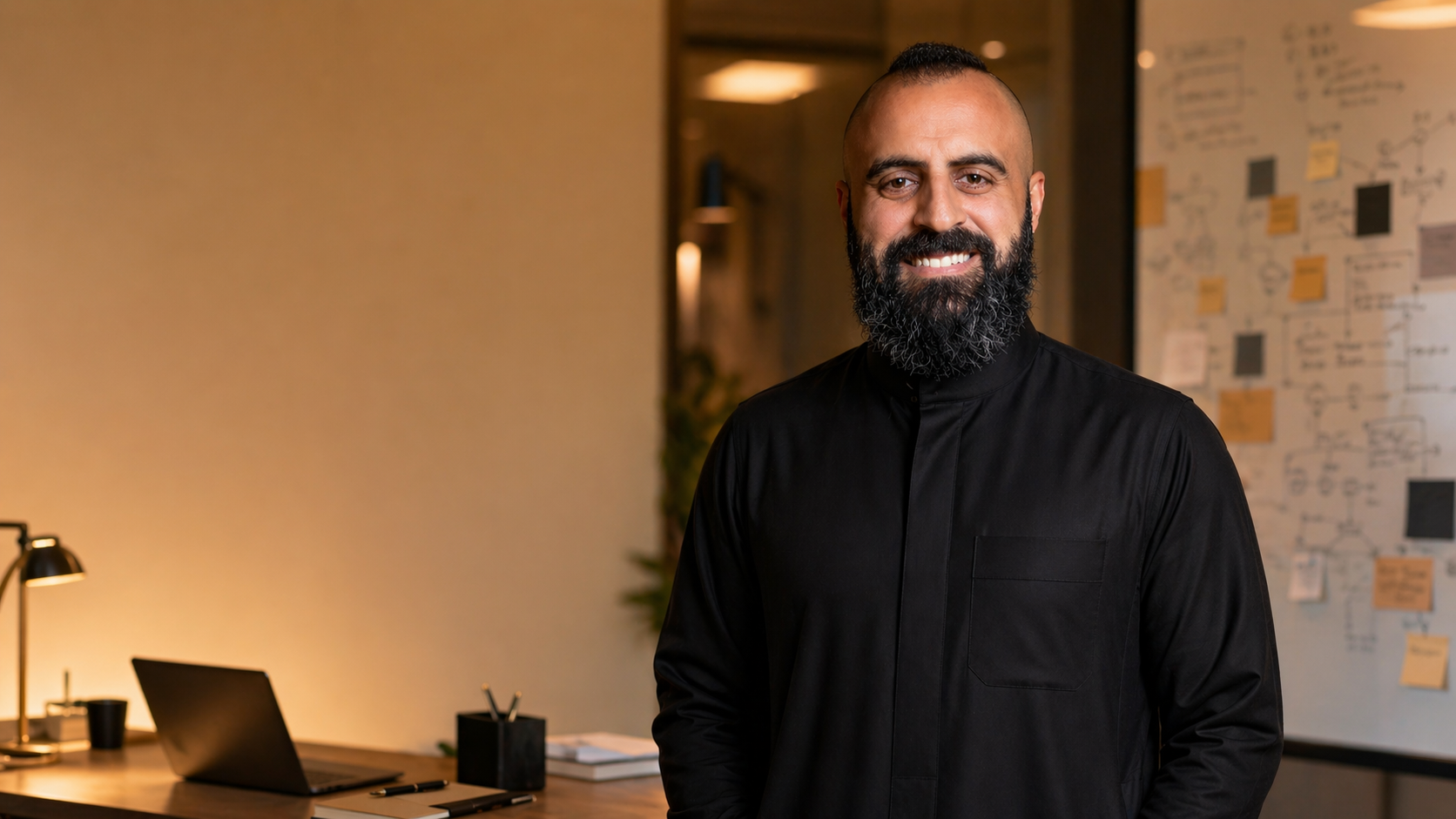


I have played the same guessing game in Lebanon, Jordan, Dubai and Egypt.
Someone meets me. They see the mohawk, the mustache, the beard, the tattoos. They hear the way I speak. Eventually they ask where I am from.
“Guess.”
They start moving around the Arab world, naming one country and then another. Saudi does not come up. When I finally tell them, I get the same reaction.
“No way.”
It has happened often enough that I find it funny. I can watch someone trying to reconcile the person in front of them with the Saudi they already have in their head. Apparently, those two images are not supposed to live in the same body.
Recently, someone left a comment on one of my YouTube videos that made the surprise less funny. He began by praising me, then told me that my tattoos, my appearance and the way I speak were not Saudi. He said I was imitating non-Muslims and should represent Saudi identity differently.
People have been saying some version of that about me since I started making content ten years ago: that I am not Saudi enough. This comment was not the first of its kind, and it will not be the last.
My first response was not very philosophical.
Go fuck yourself.
That is still the honest response. But I also remember an old joke about a man who asks a wise man for the secret to happiness.
“Never argue with idiots,” the wise man says.
“I disagree.”
“Yes, you’re right.”
I understand the appeal. I do not need to win every argument with every stranger. But when the same comment follows you for ten years, it starts to reveal something worth examining. Why does the existence of a Saudi who does not match their picture create a problem they need to solve?
You can dislike my tattoos. You can think a choice I made was wrong. You can dislike my hair, my clothes, my accent, my ideas or the way I carry myself. We can disagree. I have no need to be approved by everyone who meets me.
But your disapproval does not give you the authority to decide whether I belong to my own country.
And if my appearance makes me less Saudi, then what appearance makes someone properly Saudi? What should we wear? How should we speak? Where are we allowed to think differently, and how much variety is permitted inside this norm you have prescribed for us?
The questions begin to sound absurd when you say them out loud, but the pressure behind them is real. Saudi identity can become a box built from clothing, language, religion, family, region, class and whatever else the person doing the judging happens to consider normal. Usually, they have not built that definition consciously. They have confused the Saudis they know with all the Saudis who can exist.
I have spent much of my life inside that confusion.
When I was in Canada, I was the Saudi. When I was in Saudi, I was the Canadian. I grew up here but went to an international school. English became the language in which I could move most easily, while Arabic sometimes made me self-conscious. My loyalty was always with Saudi, even when different rooms kept assigning me different roles.
The thing I eventually understood is that I already belonged. I was not waiting for Canada, an international school, an Arab crowd or a stranger online to certify me. Being questioned irritated me precisely because I knew where I belonged.
It still took me time to become comfortable with the fact that the pieces of me did not always match the picture other people carried. For years, I adjusted. Sometimes I explained myself or made myself easier to understand. Sometimes I enjoyed being the unusual Saudi in the room. Sometimes I was tired of it. Both reactions were honest.
What interests me now is the contradiction between the future we say we want and the sameness we still try to enforce.
We talk about innovation, transformation, entrepreneurship, new Saudi brands and new ways of working. We want people to imagine things that did not exist before. Then someone moves differently, looks unfamiliar or thinks outside the expected range, and the instinct is to pull them back into line.
We want change, but we are not always comfortable with changed people.
I keep returning to the idea that innovation often comes from the edges, although I do not mean that the most extreme person is automatically the wisest. Rebellion is not automatically progress. Most unusual ideas are probably useless, and some traditions carry knowledge that the person trying to break them has not yet understood.
What the edge can give you is line of sight. With one foot outside a system, you can sometimes see the rules that people at the center have stopped noticing. You ask why something has to work that way. You notice what is missing. You combine things that existing categories have kept apart.
I suspect that position had something to do with Diggn’It.
We did not invent beards, scent, oils or the relationship men in our culture already had with grooming and presentation. Those things were familiar. What we saw was a contemporary expression that was missing: an Arab men’s grooming brand that could be playful, stylish and rooted here without copying someone else’s idea of what either “Arab” or “modern” had to look like.
I was inside enough to recognize the culture and outside enough to ask why that version did not exist yet.
Diggn’It did not happen because I had a mohawk or tattoos. It happened because a group of us did the work. Samya, our partners, friends, family and customers all carried parts of it. Still, I think my comfort with not fitting neatly helped me see a category that other people had accepted as absent.
A changing society should be careful not to crush that kind of difference. This does not require us to treat every outsider as a secret genius or every tradition as an enemy. Saudi identity should not become so loose that it means nothing. A country needs memory, shared language, commitments, responsibilities and things people recognize in one another. It just cannot require every person to become a copy.
The Saudis I know do not all look, sound, think or live the same way. Why would they? Saudi contains different regions, families, accents, histories, tastes, levels of religious practice, ideas and ambitions. I do not claim to represent all of them. No single Saudi does, including the person telling me how a Saudi should look.
The religious part bothers me for a related reason. I am Muslim. Proudly Muslim. I just do not match the version of a Muslim this man believes he has the authority to define. If he believes something I have done is wrong, he can say that. But seeing tattoos, hearing an accent or disliking the way I look does not give him ownership over my faith. He does not know me, and that authority was never his.
My faith and nationality are not costumes I wear correctly for the approval of strangers.
Sometimes I joke that Saudis either love me or hate me. I imagine most are indifferent. Haha. The internet does not show you the indifferent people very often. It shows you the person who sees a mohawk and thinks, cool, and the person who sees the same mohawk and thinks the country is under attack.
I do not want to build my identity from either reaction.
I have become comfortable with who I am and with the differences I carry. I meet people like me, and I meet Saudis, but I do not often meet Saudis like me. That can feel lonely. It can also give me a useful angle on the room.
For years, people have looked at me and tried to solve what they saw as a contradiction: Saudi, Muslim, mohawk, mustache, beard, tattoos, English-shaped speech and ideas that do not always sit in the center.
I no longer experience those things as a contradiction. They live together because I do.
You do not have to like the combination or understand it. You do not have to approve of me. I am still Saudi. I am still Muslim. I am not asking your permission for either.
The harder question is whether our idea of Saudi is large enough to recognize the Saudis who are already here.