
I Once Watched a Room Change Its Mind
A university seminar made changing a mind visible: vote, explain, listen and choose again. It left me wondering whether open-mindedness belongs only to the person, or partly to the room.
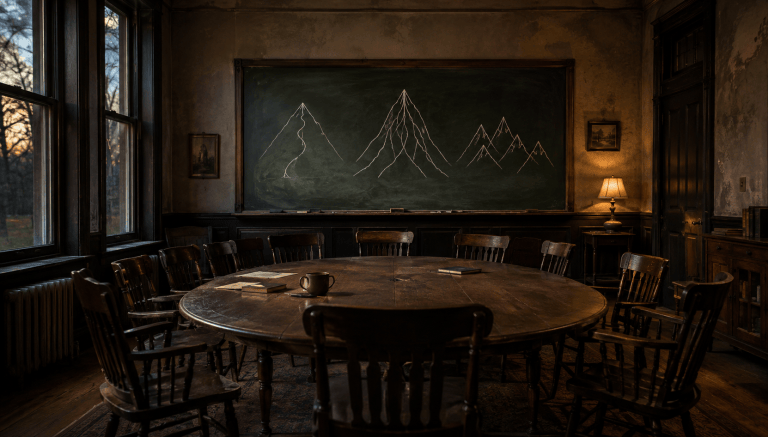
Imagine salvation is the top of a mountain. Is there one path to the top? Are there many paths to the same top? Or are there many mountains?
That last question blew my mind.
The first time I watched a room change its mind, there were two numbers on a board.
I was at university in Toronto, taking a course I remember as Pluralism and Dialogue. The seminar met in an old Victorian building. About ten of us sat around a table where everybody could see everybody else. It was not the kind of classroom where you could choose a seat at the back, look thoughtful and disappear.
The professor would take the week's readings and turn them into a fictional debate. One character argued one position. Another challenged it. The reading stopped being something we had to summarize and became a conflict we had to enter.
Before the discussion began, everybody voted for the position they found more convincing. The professor wrote the tally on the board.
Then we went around the table.
Everybody had to speak. Everybody else had to listen while that person spoke. You had to explain why you chose your side, which part of the argument convinced you, what bothered you and what you thought the reading meant. It was difficult to float through the class pretending to have an opinion. It was also harder to stay locked inside your first reaction, because the person across from you was going to get a full turn too.
I had grown up in a religious environment where certainty carried a kind of status. People who spoke with certainty sounded stronger. I had also reached university with gaps in what I understood about the religious world I had grown up inside. The course did not replace one set of final answers with another. It gave me a way to remain inside a question without treating the question itself as betrayal.
Many paths to the same mountain felt generous. It allowed different routes while quietly assuming that everybody was trying to arrive at the same place. Many mountains changed the frame. It asked whether different traditions were even trying to answer the same question in the same way.
At the end of the seminar, we voted again.
The professor turned back to the board and wrote the second tally beside the first. Sometimes the room moved. Sometimes it did not move much. The numbers were right there. You could see whether listening to one another had changed anything.
That physical image stayed with me: two sets of numbers on a board, before and after people had been asked to explain themselves and hear one another out.
Before that class, I thought of thinking as something that happened privately. You sat alone, formed an opinion and brought the finished thing into the room. The seminar showed me that thinking could also happen between people. Another person's reasoning could reveal a gap in mine. Explaining myself aloud could show me that my own position was thinner than it had felt inside my head. I could begin a conversation certain and leave it less certain without leaving empty.
I still catch myself describing open-mindedness as though it lives entirely inside a person. Someone is curious or stubborn, willing to listen or unwilling. That room makes me ask a different question: what is the conversation asking the person to protect?
Some conversations make every position feel like a public identity. Moving then looks like losing. The seminar gave us a less dramatic sequence. Take a position. Give your reasons. Let the other person finish. Then decide again.
The second decision did not have to be different. That matters. A changed tally was not proof that the room had become wiser. People can move together and still be wrong. The professor had not found a method for manufacturing agreement.
What he had built, at least in my experience of it, was somewhere for movement to happen.
I cannot know how every student experienced seeing the votes on the board. For me, changing a position became visible without automatically becoming an embarrassment. The vote was the best answer I had before the conversation. The second vote let me find out whether that answer still held afterward.
Years later, I do not remember every reading from that course. I remember the table. I remember having to face the other people around it. I remember the professor writing the first tally, then returning to the board after everybody had spoken.
The room sometimes moved. Sometimes it did not.
But it had been designed so that all of us could think again.
I still wonder how many of the rooms we enter are actually built to let anyone do that.