
The Country I Could Not Wait to Leave
For years, Saudi was the country I could not wait to leave. Returning with my children into a changed daily life made me reconsider what freedom, family and home meant without deciding my younger self had been wrong.
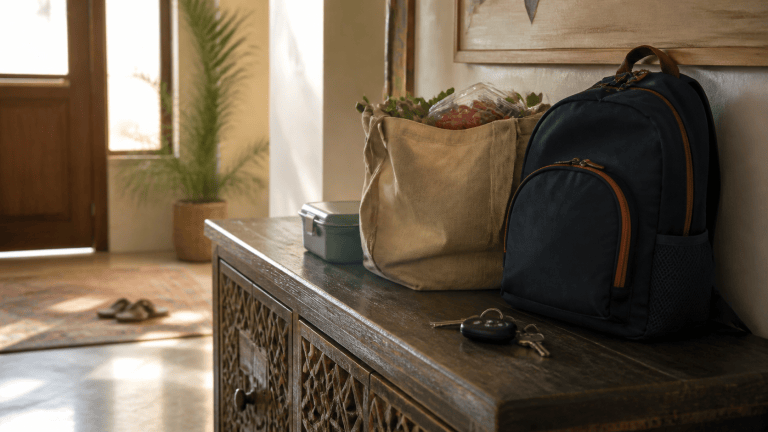
The first time I felt that I had returned to a different country was an ordinary school day.
We had moved back to Saudi. A few weeks later, school started. At first, my wife, Samya, did not feel comfortable driving here. Women had been legally allowed to drive for years by then, but we had both grown up in a country where the idea belonged to the category of impossible. A rule can change faster than the body catches up.
So I drove the kids to school in the morning, came home and began working, then stopped whatever I was doing to pick them up. Groceries and errands needed the same kind of planning. Samya either waited for me or took a ride-share. Even though I worked from home, the workday kept breaking around the car.
We practiced together on Fridays when traffic was lighter. Then one day she decided to pick up the kids on her own. I dropped them off, came home, worked and helped with lunch. Samya went to the grocery store, picked up what she needed, collected the kids and came home.
That was it. No driver. No ride-share. No interruption in the middle of my work. No family discussion about how one ordinary errand was supposed to happen.
It is hard to explain how different that day would have felt in the Saudi Arabia I grew up in. It is even harder to explain how strange it was for me to be the person who had come back to live it.
For a long time, Saudi was the country I could not wait to leave.
I did not hate it. That version is too simple. I was born in Canada to Saudi parents and moved to Saudi when I was young. Saudi was home, family, food, weather, school, religion, rules and all the things a child accepts as the shape of the world.
Then my parents began sending my brother and me to summer camp in Canada. Canada gave me another point of comparison. People moved differently there. Children had a different kind of independence. Conversations happened that I did not hear in Saudi. I would return with new information and try to fit it into the life I already knew.
The comparison became normal before I understood what it was doing to me. When I was in Canada, I was Saudi. When I was in Saudi, I was the Canadian.
I felt loyal to Saudi wherever I was. If someone reduced it to a stereotype, I wanted to correct them. I also knew what it felt like to be young there in the 1990s and early 2000s, when the future could feel more assigned and self-expression could carry more consequences than it seemed worth.
Canada showed me that the life I grew up in was not the only way life could be arranged. Movement began to feel like freedom. If I wanted to learn, I left. If I wanted to see what else I could become, I left. If I felt restricted, somewhere else looked like the answer.
That instinct gave me a life. Canada became part of my language, my history and my family. It was never only the place outside Saudi. It was one of my countries. It gave me people I love, a different way of seeing and enough distance to learn that no country has a monopoly on normal.
It also taught me something I did not understand when I was younger: ordinary life can become difficult anywhere. When Samya and I were raising young children in Canada, the difficulty was the particular loneliness of doing family life without a daily extended-family net around us.
Samya and I share the same birthday, January 1. Before children, that sounded like a gift from the calendar. The whole world stayed awake and counted down with us. After children, New Year's became a stay-home-and-try-to-stay-awake kind of night. If we wanted to see people, sometimes one of us went and the other stayed with the kids.
On a visit to Saudi before we moved back, the same night felt completely different. The kids were with their grandparents. Samya and I went to a party together. Cousins and friends were there. People from our parents' generation were there, our generation was there and younger people were there too. Everybody was ushering in the new year in the same room.
I remember thinking: this is just a nice quality of life. The sentence is probably too small for the way people like to explain a move between countries, but it held the parts of life that had begun to matter more to us. Our children were loved by more than the two people doing the daily work of raising them. We could be parents and still be people together. The children could know grandparents, cousins and family rhythms from the inside.
Fatherhood had changed the questions I asked of a place. When I was young, the question was: can I become myself here? With children, another question became louder: can they become themselves here?
Would Arabic be a living language for them or something we tried to preserve through lessons and reminders? Would Saudi be home or the place their parents came from? Would they understand the jokes, the greetings, the indirectness, the warmth and the obligations because they had lived among them, or would Samya and I spend years translating a culture from across an ocean?
Every visit made those questions harder to ignore. We would come to Saudi with the kids and not want to leave. Family was part of that. The country itself also felt different from the one I remembered.
I noticed women moving through public life differently. In cafes, I saw young Saudis working, opening businesses and expressing themselves through style and grooming in ways I did not remember from my youth. Those were small observations, not a measure of the whole country. To me, they made daily life feel less fixed.
Saudi did not need to become perfect for me to feel hopeful about living there. Things do not have to be perfect. You just want to see things getting better.
At that stage of our life, Saudi felt as though it was opening. Canada, for us, felt heavier: more isolated, more expensive and less able to give our family the life around the children that we wanted. I do not make that comparison easily. Canada is part of me. It gave me much of the freedom and distance that allowed me to see Saudi clearly in the first place.
Our return was made possible by practical conditions as well as feeling. The family network was here. A daily life we wanted was here. The country had changed in ways that reached our household. Our children were at an age when Arabic and culture felt time-sensitive. We were ready to move.
The country changed. My family changed. I changed. I cannot separate those movements cleanly enough to turn this into advice about where anyone else should live.
I can only say that the younger version of me was not wrong. He was responding to the country he knew and the things he needed then. He needed exposure, movement and the knowledge that the world was larger than the life he already knew. Leaving did that for me.
Returning asked me to look again. The first story I had told myself about Saudi had stayed fixed while the life I would return to had changed. My idea of freedom had changed too. Freedom was no longer only the ability to leave. It was grandparents who could keep the kids, a wife who could get in the car without waiting for me, children beginning to absorb Arabic from the air and a future our family could participate in instead of watching from somewhere else.
The day Samya picked up the kids, nothing dramatic happened. She came home. The children came home. I kept working. The day continued.
I was sitting in the country my younger self remembered, living a day he could not have imagined. I am glad he left. I am also glad I knew when his story was no longer enough.